Tracing Bamboo Furniture’s Beginnings

If left unchecked, bamboo’s root systems are a force to be reckoned with for any gardener. When we think of bamboo as a decorative material, on the other hand, the word that comes to mind is pervasive, as opposed to invasive (and minus the negative connotation). The longstanding success of two bamboo-centric pieces in the Bunny Williams Home collection, the Bamboo Bed and Bamboo Sofa, are a reminder of how the material’s form lends sophistication and a laid-back sensibility to any style interior. So today we have resolved to dig into the plant’s extensive roots in interiors: namely, to explore its use and inspiration for furniture design.
Bamboo is not a type of wood, but rather a giant of the grass family, easily recognized by its towering, knobbed, tubular stems. It is incredibly strong (three times stronger than timber, to be precise) but also highly flexible and snap-resistant (it is stronger than steel as far as tensile strength). Most varieties are naturally hollow, lightweight, and easy to transport. These qualities, among others, made it a natural candidate for a wide array of early applications before it was used for furniture.
Though now native in most areas of the world, bamboo is thought to have originated in China and southeast Asia, where the earliest bamboo artifacts were discovered. Archeologists digging in China’s Shaanxi province near its capital city Xi’an discovered archives written on bamboo slips that date back to the Han Dynasty (206 BC-220 AD). During the Western Jin Dynasty (265-316 AD) the first known bamboo-related research was recorded in a book listing more than sixty different species native to China.

Since its first applications, bamboo has had a strong cultural impact. In the 600s, the Tang Dynasty (618-907) utilized bamboo to make musical instruments. Dizi, a type of flute usually crafted from a bamboo stalk, later became a key instrument in the Kunqu opera, which first appeared in the late Yuan Dynasty (1271 -1368) and is considered a key inspiration for other traditional operas including the Beijing Opera. By the Song Dynasty (960-1279), bamboo permeated the day-to-day lives of Chinese people. They wrote on paper and wore clothes crafted from the material, used it as firewood, and utilized it in popular dishes.
The first record of a bamboo chair is also recorded in China during the Song Dynasty. Given the high regard of the chair at this time–as a furniture form it represented the seat of authority–it’s also likely that bamboo started to become an acceptable cabinet wood in this era. Bamboo continued to make its way indoors during the Ming Dynasty (1368-1644) starting in the 1300s. During this period, bamboo was increasingly used to create bedding and flooring.
Early bamboo furniture designs varied from primitive to decorative. Common household furniture in more rural regions was simply constructed with bamboo frames that were left open on the ends and bamboo strips for panels. On the other hand, more elaborate designs featured latticework or tightly packed surface decoration, multiple bamboo stalks bound together for legs, lacquered surfaces, and even ivory capped ends.

During the Qing Dynasty (1644-1911), China’s last ruling dynasty, the influence of Chinese design took deeper root in the Western world. The European interpretation and imitation of Chinese and East Asian decoration, known as chinoiserie, came to a head in the mid-1700s. Two important tomes were published in 1754: Thomas Chippendale’s Gentleman and Cabinet-Maker’s Director, and Edwards and Darly’s New Book of Chinese Designs. Both volumes included a vast depiction of chinoiserie designs.

The first illustrations of Chinese bamboo furniture to appear in Britain were those in Sir William Chambers’ Chinese Designs, published in 1757. Chambers’ sketches were made during his visits to Canton (now better known as Guangzhou) in the 1740s with the Swedish East India Company. Though not originally intended for publication, Chambers eventually asserted that his illustrations could be used as prototypes for English cabinetmakers. Still, there’s little evidence that they actually widely produced bamboo furniture during this time, and it’s more likely that his drawings served as the basis for designs simulating bamboo.

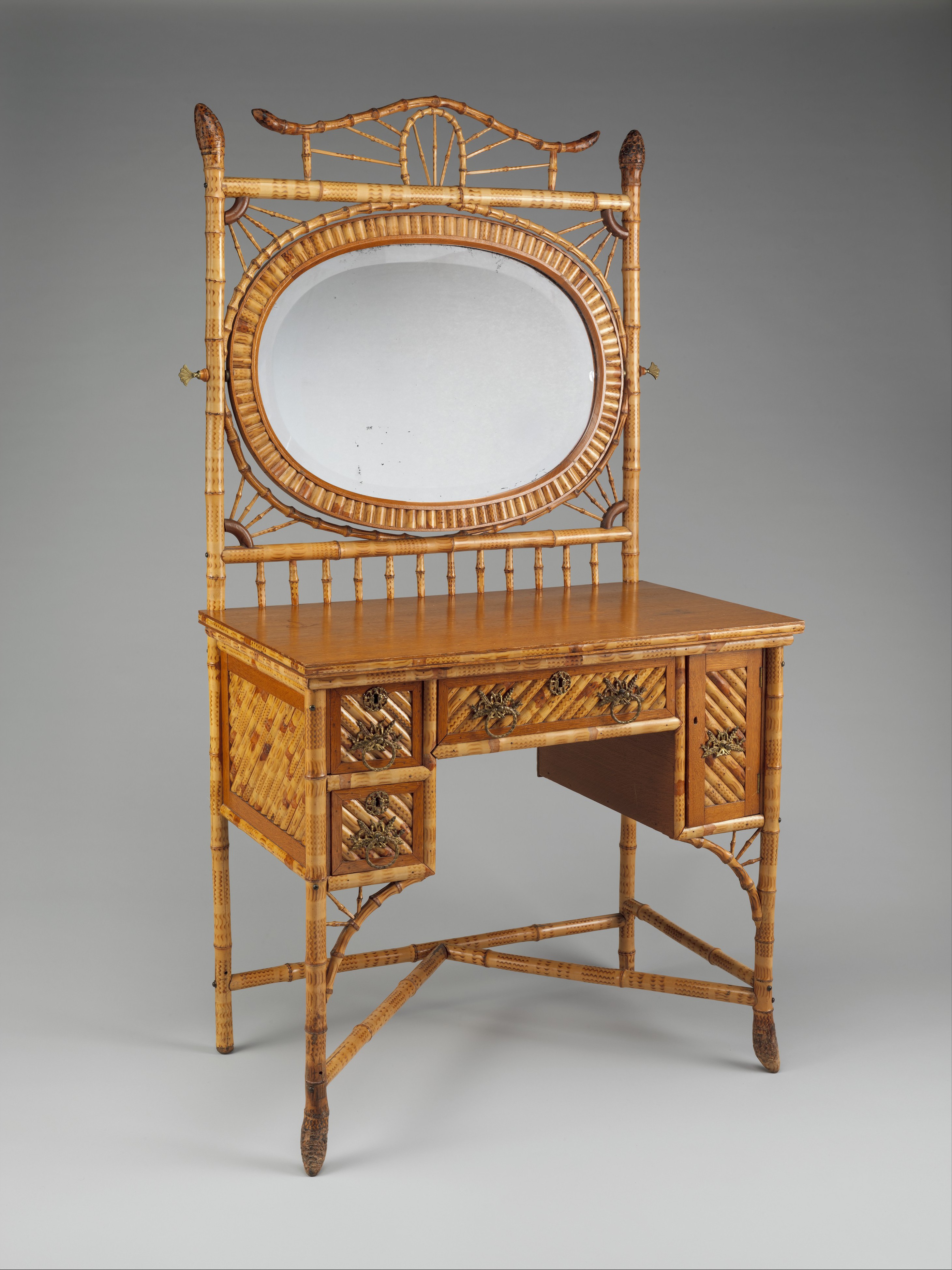
Although it proved impractical as a high quality cabinet wood, bamboo’s appearance served as a design motif that was extensively simulated in hardwoods. By the 1770s and 1780s, imitation bamboo pieces were widespread in Britain. Craftsmen built chairs, settees, occasional furniture, bedroom suites, and more to imitate bamboo, usually using beech wood as a base and then painting it. Other times, makers would apply real bamboo as a veneer atop other high quality woods.

One of the most notable examples of chinoiserie, and of the extensive use of bamboo as a design motif, lies on the southern coast of England. Completed in 1823, the Royal Pavilion at Brighton, (also called the Brighton Pavilion) was built as a seaside home for George IV, Prince of Wales.

Bamboo abounds in the interior in the form of both real and imitation bamboo furniture, along with an extensive use of bamboo motifs for wallpaper, frames and railings. The interior was modified many times over, though architect John Nash gets due credit for the Brighton Pavilion we know today, including its grand, cast iron staircases which were painted to resemble real bamboo.

Above left, a late 18th-century chair, probably Chinese, crafted from bamboo and rattan with ivory caps. Next to it, on the right, is an early 19th-century Regency ‘Brighton Pavilion’ bamboo armchair with peach cotton squab cushion.
Though bamboo went in and out of fashion throughout history (and we’ll by no means assert this as a comprehensive history), faux bamboo furniture made its comeback in a big way as a welcome change to heavy Victorian styles. The Exposition Universelle of 1867, a world’s fair held in Paris, reignited the chinoiserie craze and sparked high demand for Japanese furniture in particular.

Japan had opened up trade in 1854 and was increasingly exporting wares to Western countries, including bamboo furniture. Unable to satisfy growing demand, faux bamboo furniture again rose to meet the need. European and American craftsmen employed stained birds-eye maple and pine to recreate bamboo and large suites of bedroom furniture were widely produced during this era.

We see one such example in Howard’s End, the Merchant Ivory film set in the Edwardian Era, when Margaret Schlegel comforts her under the weather Aunt Juley in a large, faux bamboo bed with a matching dresser nearby. The faux bamboo bed seen above was sourced by our interior design team for a guest bedroom for a project in East Hampton.
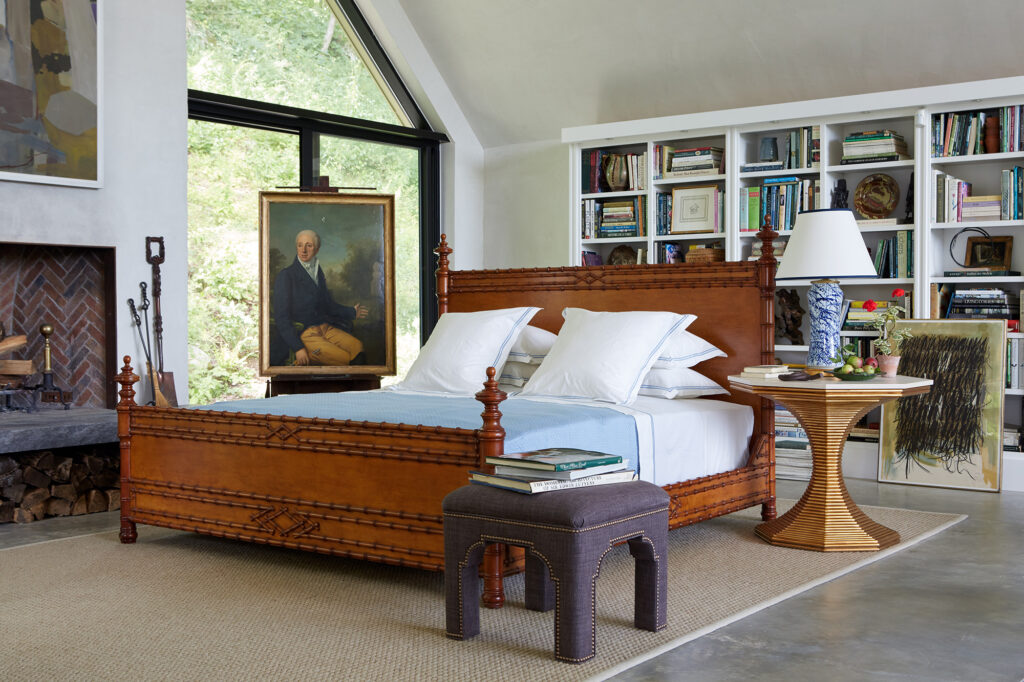
The Bamboo Bed in the Bunny Williams Home collection has long been a favorite, and we recently introduced it in a Twin size. Ours is made of faux bamboo, crafted from poplar wood and bird’s eye maple veneer with a walnut finish. It is available in a King, Queen, or Twin size, with King and Queen size headboards also available separately.

Another favorite piece, our Bamboo Sofa is set atop an open base made of faux bamboo, which is available in four finishes: mahogany (seen here), ebony, alpine (an antique white) or a true white. It’s a detail that undoubtedly lends the piece personality. Perhaps more importantly though, it’s one built on centuries of admiration and reinterpretation of a material we are always more than willing to invite indoors.
Cover photo: The South Galleries at the Royal Pavilion in Brighton.

